
How to Organize Deep Kitchen Cabinets Without Wasting Space
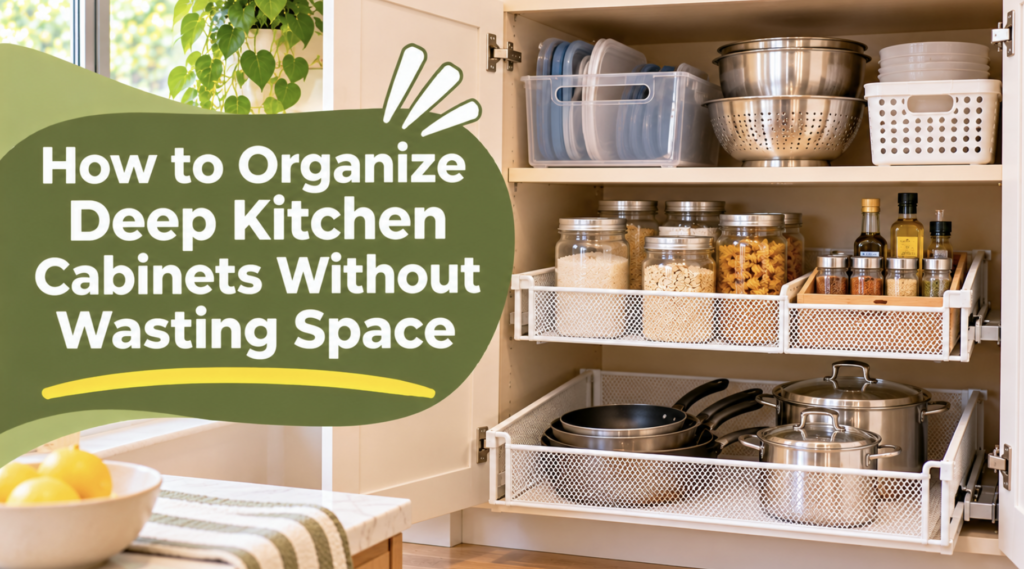
Deep kitchen cabinets can hold a surprising amount of cookware, dishes, and pantry supplies. However, that extra depth isn't always helpful. Items pushed toward the back often become difficult to reach, smaller products disappear behind larger ones, and finding a particular pot can turn into a frustrating search.
The problem isn't necessarily that you need more storage. You may simply need a better way to arrange what you already have.
The best way to organize deep kitchen cabinets is to group similar items, keep frequently used belongings accessible, and use storage solutions that make the back of each shelf easier to reach.
Here are practical ways to make deep cabinets more functional without overcrowding them.
1. Empty the Cabinet and Measure Its Interior
Start by removing everything from the cabinet you're organizing.
Separate the contents into categories such as cookware, dishes, food containers, and small appliances.
Check for damaged items, duplicate utensils, and belongings that would work better somewhere else.
Once the cabinet is empty, measure its interior width, depth, and height.
Pay attention to hinges, pipes, shelf supports, and other features that could affect storage accessories.
These measurements will help you determine whether pull-out baskets, shelf organizers, or simple containers are appropriate.
Clean the shelves and allow them to dry before returning anything.
2. Divide the Cabinet Into Practical Storage Zones
Instead of treating the entire cabinet as one large storage area, divide it into smaller sections.
For example, one section can hold pots and pans, another can store food containers, and a separate shelf can accommodate mixing bowls.
Keep related items together so you don't have to search multiple locations when preparing a meal.
If your kitchen has several deep cabinets, assign each one a primary purpose.
This approach also prevents unrelated belongings from gradually taking over available space.
For more general kitchen storage advice, see our guide on organizing a small kitchen with limited cabinets.
3. Keep Frequently Used Items Near the Front
One of the biggest problems with deep cabinets is forgetting what is stored behind the first row of items.
Place frequently used cookware and kitchen essentials toward the front.
Occasional-use items can occupy the back section, provided they remain accessible.
For example, everyday frying pans should be easier to reach than a large roasting pan used only occasionally.
Avoid placing heavy objects behind lighter belongings if retrieving them requires moving several items.
A practical arrangement should reduce unnecessary lifting and searching.
4. Use Pull-Out Organizers When Appropriate
Pull-out baskets and sliding shelves can make deep cabinets easier to use.
Instead of reaching toward the back, you can bring the stored items closer to the cabinet opening.
These organizers can work well for cookware, food containers, and suitable pantry supplies.
Before purchasing one, check the cabinet dimensions and confirm that the product is compatible with its construction.
Consider the installation requirements, weight capacity, mounting hardware, and clearance needed for the organizer to move freely.
Some systems require drilling or professional installation, so check whether they are suitable for your kitchen.
You don't need a pull-out system in every cabinet. Use one only where it solves a genuine accessibility problem.
5. Organize Pots and Pans by Size
Pots and pans can occupy considerable cabinet space when they're stored randomly.
Group cookware by size and shape.
Where the design allows, nest compatible pots together, placing protective material between surfaces that could scratch.
Keep lids in a separate suitable holder or in an organized section beside their corresponding cookware.
Avoid stacking heavy pans in unstable piles.
If you use certain pans every day, keep them in the most accessible position.
This makes cooking easier and reduces the need to rearrange the entire cabinet whenever you need a particular item.
6. Create Order Among Food Containers
Food containers often become difficult to manage because their shapes and lids don't match.
Start by pairing each container with its correct lid.
Nest compatible containers together when their design allows.
Separate lids into a suitable basket or organizer so they remain visible.
Discard or recycle damaged containers according to local guidelines.
Avoid stacking containers so tightly that removing one causes everything else to fall.
If you store food in the cabinet, use only suitable food-safe containers and follow the storage instructions for each product.
7. Make Use of Vertical Space
Deep cabinets sometimes have considerable unused space between shelves.
A suitable shelf riser can create another storage level for lightweight items such as bowls, cups, or small plates.
Adjustable organizers may also help separate baking trays, cutting boards, and other flat kitchen items.
Before installing anything, measure the available height and check the accessory's stability and weight limits.
Don't overload upper shelves with heavy cookware.
Keep frequently used and heavier belongings at comfortable, accessible heights.
8. Store Small Items in Separate Containers
Small kitchen accessories can easily become scattered across deep shelves.
Measuring cups, baking tools, reusable bags, and similar items may be easier to manage inside appropriately sized containers.
Use simple labels if different categories are difficult to distinguish.
Choose containers that can be removed without disturbing neighboring items.
Avoid using excessively large baskets that encourage you to combine unrelated belongings.
A good organizer should make items easier to find, not simply hide clutter behind another container.
9. Avoid Filling Every Inch of the Cabinet
Having extra space doesn't mean you should fill it completely.
Overcrowded cabinets make it harder to retrieve cookware and can increase the risk of items falling.
Leave enough room to remove containers, open doors, and move shelves or drawers where applicable.
Pay attention to the cabinet's weight limits and installation specifications.
If you have more belongings than the available storage can comfortably accommodate, consider relocating occasional-use items or reviewing what you actually need.
A functional cabinet is more useful than one packed from front to back.
10. Maintain Your Cabinet With a Simple Routine
Once the cabinet is organized, return each item to its designated section after use.
Avoid placing newly purchased kitchen supplies wherever an empty space appears.
When putting away groceries or cookware, check whether the existing arrangement still makes sense.
Every few weeks, straighten containers, match lids, and remove items that no longer belong there.
Small adjustments can prevent the cabinet from becoming disorganized again.
Final Thoughts
Organizing deep kitchen cabinets is about making every stored item easier to access.
Start by measuring your shelves, grouping similar belongings, and placing frequently used items near the front.
Consider pull-out organizers or shelf dividers only when they solve a specific storage problem.
With a thoughtful layout and simple maintenance habits, deep cabinets can become practical storage spaces instead of places where useful belongings disappear.
- Pingback: How to Organize Kitchen Drawers for Maximum Space - The Organized Nook
Leave a Reply